
Holep / Thuflep
HoLEP and ThuFLEP are closed laser surgical methods used to reduce urinary complaints in benign prostate enlargement.
Prostat Merkezi
HoLEP is one of the closed prostate surgery methods used in the treatment of benign prostate enlargement. This method is applied during the prostate treatment process to reduce complaints such as difficulty urinating and weak urine flow. For patients searching for an Ankara prostate center, HoLEP surgery is evaluated among laser prostate treatment options, especially in suitable patient groups.
The phrase what is HoLEP defines a laser-assisted surgical method used for urinary tract obstruction caused by prostate enlargement. HoLEP is based on separating the inner part of the prostate that narrows the urinary canal with holmium laser energy and removing the tissue taken into the bladder with special systems. For this reason, HoLEP prostate surgery is among the prostate surgery options performed with a closed technique.
The subject of what is benign prostatic hyperplasia is important for understanding which disease HoLEP is used for. Benign prostatic hyperplasia, also known as benign prostate enlargement, is the enlargement of the prostate gland with age, causing pressure on the urinary canal. This condition can lead to complaints among prostate symptoms such as frequent urination at night due to the prostate, the feeling of incomplete bladder emptying, and prostate obstruction.
HoLEP laser prostate surgery aims to separate the enlarged tissue from its capsule rather than cutting and vaporizing the prostate tissue. This feature may allow the method to be preferred in some patients who require prostate enlargement surgery. When planning large prostate treatment, prostate volume, the patient’s general health condition, and the severity of urinary complaints are evaluated together.
HoLEP is mainly used for urinary canal obstruction caused by benign prostate enlargement. In patients requiring benign prostate surgery, the aim is to reduce the pressure created by the prostate at the bladder outlet and relieve urine flow. Therefore, when surgical options are evaluated within benign prostatic hyperplasia treatment and BPH treatment, HoLEP stands out as an important method.
The decision for BPH surgery is not made in the same way for every patient. Prostate surgery may come into consideration in patients whose complaints continue despite medication, who have significant difficulty urinating, who cannot fully empty their bladder, or who experience recurrent urinary tract problems. For patients researching how prostate enlargement goes away or what is good for prostate enlargement, the method that may provide lasting relief can be the surgical removal of the enlarged tissue.
The phrase is HoLEP used for benign prostate enlargement becomes clear at this point. The method is applied not for cancer treatment, but to relieve the mechanical obstruction caused by benign enlargement. In patients with suspected prostate cancer, the necessary diagnostic evaluations are performed first.
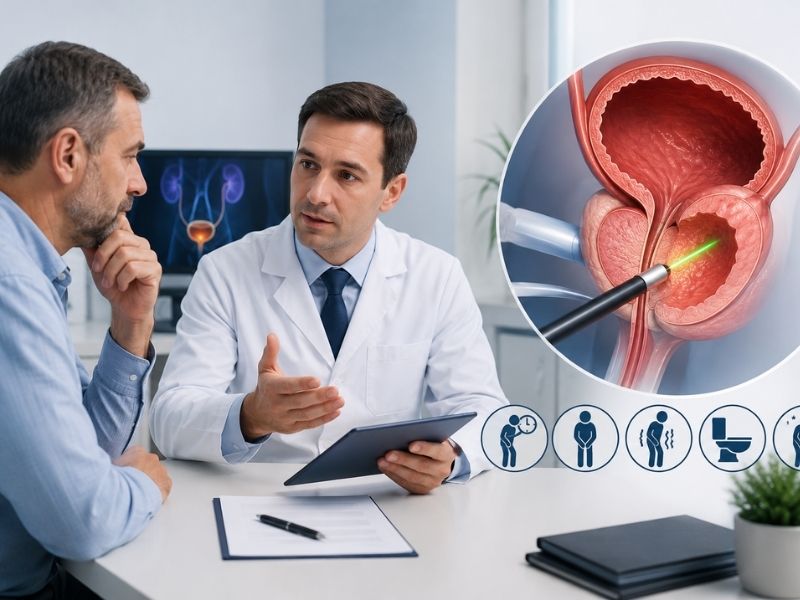
The subject of how HoLEP is performed can be understood through the logic of closed surgery. No external incision is made during the surgery; special endoscopic devices are inserted through the urinary canal. With the help of laser energy, the enlarged inner tissue of the prostate is separated from the capsule and taken into the bladder. Then this tissue is divided into small pieces and removed from the body.
The process searched with the phrase how closed prostate surgery is performed also describes a similar closed surgical approach for HoLEP. However, the laser technology used in HoLEP allows the tissue to be separated in a controlled manner. For this reason, the concepts of prostate laser surgery and laser prostate treatment are frequently evaluated together with the HoLEP method.
The answer to the question of how prostate surgery is performed may vary according to each method. Different closed methods such as what is TUR-P, plasma kinetic TUR-P and ThuFLEP can also be used in the treatment of benign prostate enlargement. Which method is suitable is determined according to prostate volume, bleeding risk, medications used, and the surgeon’s evaluation.
The subject of who HoLEP is applied to is especially important for patients who do not benefit sufficiently from medication. Surgical evaluation may be required in patients who experience weak urine flow, frequent urination, waking up at night to urinate, intermittent urination, and a feeling of not being relieved after urination. The phrase can HoLEP be applied in large prostates is also frequently researched; the method is one of the surgical options that can be applied in large prostate tissues in suitable patients.
The subject of who can undergo laser prostate surgery is not determined only by prostate volume. The patient’s age, additional diseases, use of blood thinners, bladder functions, and surgical expectations should be evaluated together. Therefore, patients searching for an Ankara urology doctor need to make a decision not only by the name of the method, but through a personal evaluation process.
Risks of HoLEP surgery should be explained individually for each patient, as with every surgical procedure. Conditions such as bleeding, infection, temporary burning, urinary incontinence, or narrowing of the urinary canal may rarely occur. However, the level of risk is related to the patient’s current condition, prostate structure, and postoperative care process.
HoLEP may be preferred in patients whose urinary outlet resistance increases due to prostate enlargement. Especially difficulty urinating, weak urine flow, the feeling of incomplete bladder emptying, and prolonged need to use the toilet can significantly affect daily life. These complaints may also strain bladder functions over time.
Frequent urination at night is one of the common complaints in prostate enlargement. The patient may have to wake up several times at night, and this can impair sleep quality. When prostate obstruction progresses, problems such as urinary tract infection, bladder stones, or sudden inability to urinate may occur.
Medications may be one of the first options in the prostate treatment plan. However, if complaints persist despite medication, urine flow is significantly impaired, or residual urine remains in the bladder, prostate surgery is evaluated. HoLEP surgery comes to the agenda at this point as a closed and laser-assisted option.
The subject of how HoLEP surgery is performed is important for patients to understand the surgical process. The procedure is usually performed under anesthesia and is applied by entering through the urinary canal. The enlarged inner tissue of the prostate is separated from the capsule with a holmium laser, released into the bladder, and removed by being fragmented with a special device.
The answer to the phrase how long HoLEP surgery takes varies according to the size of the prostate, the structure of the tissue, and the patient’s condition. While the duration may be shorter in small and medium-volume prostates, the procedure may take longer in large prostates. Postoperative follow-up is as important as the duration of surgery for treatment success.
Catheter after HoLEP is usually placed for a short period to protect the urinary tract and monitor bloody urine. The subject of when the catheter is removed after HoLEP varies from patient to patient; the decision is made by considering urine color, bleeding status, and general recovery.
Before HoLEP, the patient’s prostate enlargement, urinary tract condition, and general health structure are evaluated. Examination, blood tests, urinalysis, PSA measurement, ultrasonography, and uroflowmetry may be performed. When necessary, the amount of urine remaining in the bladder is also measured.
Prostate symptoms may not have the same severity in every patient. Therefore, the decision for surgery is not made by looking only at complaints. Prostate volume, urine flow rate, the condition of the bladder wall, and the patient’s quality of life are evaluated together.
In patients applying for Ankara prostate treatment , the process progresses by creating a diagnosis and treatment plan tailored to the individual. In patients planned for Ankara prostate surgery , the use of blood-thinning medication, heart diseases, and previous surgical history must also be reviewed.
The difference between HoLEP and TUR-P is evaluated in terms of the energy source used and the amount of tissue removed. In the TUR-P method, prostate tissue is cut and removed piece by piece with electrical energy, while in HoLEP, the enlarged prostate tissue is separated from the capsule with a laser. Therefore, the difference between laser prostate surgery and TUR-P may affect treatment selection according to the patient.
Plasma kinetic TUR-P is one of the closed prostate surgery types applied with a different energy technology compared to the classic TUR-P method. The difference between HoLEP and TUR-P is evaluated in urological assessment, especially in large prostates, patients with bleeding risk, and long-term tissue removal effectiveness.
The phrase what is TUR-P defines closed prostate surgery that has been applied for many years. HoLEP, on the other hand, has a different surgical principle as a laser-assisted tissue separation method. Which method is suitable should be determined according to prostate volume and patient characteristics.
The difference between HoLEP and ThuFLEP is basically related to the type of laser energy used. While HoLEP is performed with a holmium laser, ThuFLEP is performed with thulium fiber laser technology. The concept of ThuFLEP also refers to this laser prostate surgery approach.
Both methods are based on the principle of separating the enlarged prostate tissue from the capsule. However, technical details such as the laser’s effect on tissue, cutting precision, bleeding control, and the surgeon’s experience may vary. When evaluating the difference between HoLEP and ThuFLEP , not only device technology but also the patient’s prostate structure is considered.
Which of these methods is suitable for large prostate treatment becomes clear after a detailed urological evaluation. For patients researching Ankara laser prostate surgery, the important point is that the method is selected according to the individual and that the postoperative follow-up process is carried out regularly.

Recovery after HoLEP usually progresses gradually. Mild bleeding in the urine, burning, frequent urination, and sudden urgency may occur in the first days. These findings decrease over time in most patients. The answer to the phrase how long recovery after HoLEP takes varies according to the patient’s age, prostate size, and preoperative bladder functions.
Urinary incontinence after HoLEP may be seen temporarily in some patients. It usually occurs as urge-type leakage or mild leakage related to the recovery of muscle control. The exercises recommended by the doctor, fluid regulation, and follow-up visits are important during this process.
The subject of sexuality after HoLEP is frequently wondered about by patients. Erectile function may not be directly affected in most patients; however, dry ejaculation, which means semen flows backward into the bladder, may occur. The subject of whether HoLEP affects sexual life should be discussed openly with the patient before surgery.
In the first weeks after HoLEP, heavy lifting, intense exercise, and prolonged straining should be avoided. Drinking plenty of fluids, monitoring urine color, and using prescribed medications regularly support the recovery process. In the post-prostate surgery period, bloody urine may increase and decrease from time to time.
After the catheter after HoLEP is removed, burning while urinating or frequent urination may continue for a while. This condition usually decreases as the tissues heal. However, in cases such as fever, intense bleeding, inability to urinate, or severe pain, a doctor should be consulted without delay.
The subject of whether the prostate grows again after HoLEP depends on the amount of tissue removed and the patient’s long-term follow-up. Since the enlarged inner prostate tissue is widely removed in HoLEP, the need for repeat surgery may be lower compared to some methods; however, regular follow-up is still necessary.
Ankara HoLEP treatment is planned after a detailed urological evaluation in patients whose quality of life decreases due to benign prostate enlargement. For patients searching for Ankara HoLEP and an Ankara prostate center, the correct approach is not to focus only on the surgical method, but to perform a comprehensive evaluation from diagnosis to the recovery process.
In patients researching Ankara laser prostate surgery and Ankara prostate surgery , prostate volume, urinary complaints, PSA level, bladder function, and additional diseases should be examined together. As a result of this evaluation, the appropriate option is determined among methods such as HoLEP surgery, plasma kinetic TUR-P, or ThuFLEP.
The aim in the Ankara prostate treatment process is to relieve the patient’s urine flow, reduce complaints such as frequent urination at night and the feeling of incomplete bladder emptying, and prevent progressive problems related to prostate enlargement. HoLEP can be evaluated as an effective prostate treatment option applied with a closed prostate surgery approach in suitable patients.
During HoLEP surgery, the inner prostate tissue that blocks the urinary canal due to benign prostate enlargement is removed. This reduces prostate obstruction and improves urine flow.
Since HoLEP laser prostate surgery is performed under anesthesia, pain is not felt during the procedure. Mild burning, frequent urination, or blood in the urine may be seen for a short time after surgery.
Although recovery after HoLEP varies from person to person, many patients can return to daily life in a short time. Doctor’s approval should be awaited for heavy lifting, intense sports, and strenuous activities.
HoLEP allows the enlarged tissue to be removed with a closed method in patients who require large prostate treatment. Therefore, it may be an effective option in suitable patients planned for prostate enlargement surgery.
Urinary incontinence after HoLEP may be seen temporarily in some patients and usually decreases over time. Pelvic floor exercises and regular follow-up can support the recovery process after HoLEP.
For sexuality after HoLEP, completion of the recovery process and doctor’s control are usually required. Erectile function may be preserved in most patients, but changes such as dry ejaculation may occur.
The urology department should be consulted for Ankara HoLEP treatment. During Ankara prostate treatment and Ankara laser prostate surgery, prostate volume, urinary complaints, and general health status are evaluated together.
HoLEP and ThuFLEP are closed laser surgical methods used to reduce urinary complaints in benign prostate enlargement.

Rezum is a minimally invasive treatment method that aims to reduce urinary complaints caused by benign prostate enlargement. Complaints such...
You can quickly search HoLEP, ThuFLEP, prostate fusion biopsy, robotic surgery and other topics.